

GB Rail Training
Loading...
Browse and take your railway safety assessments.

Free until 5 December 2026. Sign-up needed.These changes to the Rule Book come into force on 5 December 2026. Read the list of changes below. Then take the assessment. 14 questions. Pass mark 95%. Time allowed: 15 minutes.Download the one-page list of changes (PDF)What is newTwo types of possession now have names: with engineering controls, and without. You confirm the procedure and the protection method with the signaller. (s1, 4.1)Engineering controls: four methods. Signalling disconnection, RA T-COD (remotely activated track circuit operating device), RDSE (device that remotely disconnects signalling equipment) and SCAP (signalling controlled assisted protection). (5.1) For SCAP you confirm the approvals, that the equipment works normally, and the planned reference number. (5.5) To remove SCAP, you give the signaller the authority number. (18.1)Without engineering controls: detonator protection goes 200 metres beyond the protecting signal and 200 metres on the approach to the signal beyond the possession. With points or through crossings: 200 metres beyond or on the approach to them. (6.2)You can change the protection method only in exceptional circumstances. Operations Control must agree. (3.2)Back-to-back possessions with engineering controls: allowed only if both have engineering controls, or only one has them and no engineering train moves between them. The signal between them must be one the signaller can put to danger. (4.3)WSMBs with engineering controls: at least 200 m from the protecting signal. No work within 300 m of the signal. If 200 m is not possible, place the WSMB as far as possible. No work within 100 m of it. (8.3) Tell the signaller where the first and last WSMBs are if engineering trains are planned. Not needed for OTP only. (8.3)You no longer give the ES your "full initials". You authorise the work to start. (8.5)Transient work sites replace "work outside a work site". The old 25 mph rule has gone. (s9)Only two types of work: patrol, inspect or examine without disturbing the infrastructure; place or remove temporary or emergency speed restriction boards, indicators and AWS magnets.Before an engineering train or OTP enters, you tell the ES to stop work and give up the site. The ES sets it up again only after the movement has passed out.No WSMBs are needed between two work sites that have WSMBs.Movements with engineering controls (s10):Only the SPICOP can authorise the signaller to let a train into the possession.Only the ES can authorise a movement past a WSMB into a work site.Only the SPICOP can authorise a movement to leave a work site, except the last one.At the last WSMB the signaller personally authorises the driver to pass it. If the last WSMB is not in the signal section before the exit signal, the train stops at a set place and the SPICOP confirms TPWS is reinstated.Propelling outside the first and last WSMBs is not allowed with engineering controls. Entering in the wrong direction only if published. Leaving in the wrong direction only in an emergency, with Operations Control authority. (12.4)Assisting a failed train: the SPICOP reaches a clear understanding with the signaller about the arrangements before the train enters the possession. (12.2)If the first or last WSMB changes, you tell the ES and the signaller. (s15)Giving up the possession. With engineering controls: you remove the controls, then agree the arrangements with the signaller. That agreement is the confirmation. (s18) Without engineering controls: the signaller reads back "the details recorded", not "the Train Register entry". (19.3)Source: GERT8000-HB11 Issue 12 (in force 5 December 2026). Section numbers are in brackets.

Free until 5 December 2026. Sign-up needed.These changes to the Rule Book come into force on 5 December 2026. Read the list of changes below. Then take the assessment. 14 questions. Pass mark 95%. Time allowed: 15 minutes.Download the one-page list of changes (PDF)What is newTwo types of possession now have names: with engineering controls, and without. You confirm the procedure and the protection method with the signaller. (s1, 4.1)Engineering controls: four methods. Signalling disconnection, RA T-COD (remotely activated track circuit operating device), RDSE (device that remotely disconnects signalling equipment) and SCAP (signalling controlled assisted protection). (5.1) For SCAP you confirm the approvals, that the equipment works normally, and the planned reference number. (5.5) To remove SCAP, you give the signaller the authority number. (18.1)Without engineering controls: detonator protection goes 200 metres beyond the protecting signal and 200 metres on the approach to the signal beyond the possession. With points or through crossings: 200 metres beyond or on the approach to them. (6.2)You can change the protection method only in exceptional circumstances. Operations Control must agree. (3.2)Back-to-back possessions with engineering controls: allowed only if both have engineering controls, or only one has them and no engineering train moves between them. The signal between them must be one the signaller can put to danger. (4.3)WSMBs with engineering controls: at least 200 m from the protecting signal. No work within 300 m of the signal. If 200 m is not possible, place the WSMB as far as possible. No work within 100 m of it. (8.3) Tell the signaller where the first and last WSMBs are if engineering trains are planned. Not needed for OTP only. (8.3)You no longer give the ES your "full initials". You authorise the work to start. (8.5)Transient work sites replace "work outside a work site". The old 25 mph rule has gone. (s9)Only two types of work: patrol, inspect or examine without disturbing the infrastructure; place or remove temporary or emergency speed restriction boards, indicators and AWS magnets.Before an engineering train or OTP enters, you tell the ES to stop work and give up the site. The ES sets it up again only after the movement has passed out.No WSMBs are needed between two work sites that have WSMBs.Movements with engineering controls (s10):Only the PICOP can authorise the signaller to let a train into the possession.Only the ES can authorise a movement past a WSMB into a work site.Only the PICOP can authorise a movement to leave a work site, except the last one.At the last WSMB the signaller personally authorises the driver to pass it. If the last WSMB is not in the signal section before the exit signal, the train stops at a set place and the PICOP confirms TPWS is reinstated.Propelling outside the first and last WSMBs is not allowed with engineering controls. Entering in the wrong direction only if published. Leaving in the wrong direction only in an emergency, with Operations Control authority. (12.4)Assisting a failed train: the PICOP reaches a clear understanding with the signaller about the arrangements before the train enters the possession. (12.2)If the first or last WSMB changes, you tell the ES and the signaller. (s15)Giving up the possession. With engineering controls: you remove the controls, then agree the arrangements with the signaller. That agreement is the confirmation. (s18) Without engineering controls: the signaller reads back "the details recorded", not "the Train Register entry". (19.3)Source: GERT8000-HB11 Issue 12 (in force 5 December 2026). Section numbers are in brackets.

Free until 5 December 2026. Sign-up needed.These changes to the Rule Book come into force on 5 December 2026. Read the list of changes below. Then take the assessment. 13 questions. Pass mark 95%. Time allowed: 15 minutes.Download the one-page list of changes (PDF)What is newYou confirm the possession procedure and protection method with the PICOP. They must be as published. (3.1)With engineering controls: place the WSMB at least 200 m from the protecting signal or possession exit signal. No work within 100 m of the WSMB. If 200 m is not possible, place it as far as possible. Movements towards that WSMB need the PICOP's permission. (3.4, 6.6)If WSMBs are not provided, no work within 200 m of the protecting signal (with engineering controls). (3.4)If you are the first or last work site, you give the PICOP the location of the entry or exit WSMB. Give mileage and structures. (3.4)The PICOP gives you "authority to allow work to start". The words "full initials" have gone. (3.6)Transient work sites. (3.7) Same two types of work. Record on the RT3199. Give up the site before a movement enters. Do not ask to set up again until it has passed out. You may allow work within 100 m of the end of a transient work site, with PICOP permission.For the work site, you no longer get the COSS or IWA to sign the RT3199. (4.1, 4.2) In a protection zone they still sign. (12.4)The "20 mph through the site of work" rule for lookout warning in darkness or near a tunnel has gone.Trolleys: no trolley on the line or moving within 200 m of a protecting or possession exit signal without the signaller's permission. (6.7)Leaving the last work site with engineering controls. (6.9) You tell the PICOP. You remove the WSMB when told, and replace it after the movement.Shortening or lengthening a work site: only if planned and published, and only with PICOP permission. Do not remove old WSMBs until the new ones are in place. Tell the PICOP where they are and say if they are first or last. (s10)Giving up: if you were the first or last work site with engineering controls, you tell the PICOP. (11.3) Record on Appendix B of the RT3199 when an isolation COSS is used. (11.1, 11.2)Protection zone: limits start at least 200 m beyond the protecting signal. A wrong-direction movement must not bring the train within 200 m of the protecting signal. (12.1, 12.6)Source: GERT8000-HB12 Issue 12 (in force 5 December 2026). Section numbers are in brackets.
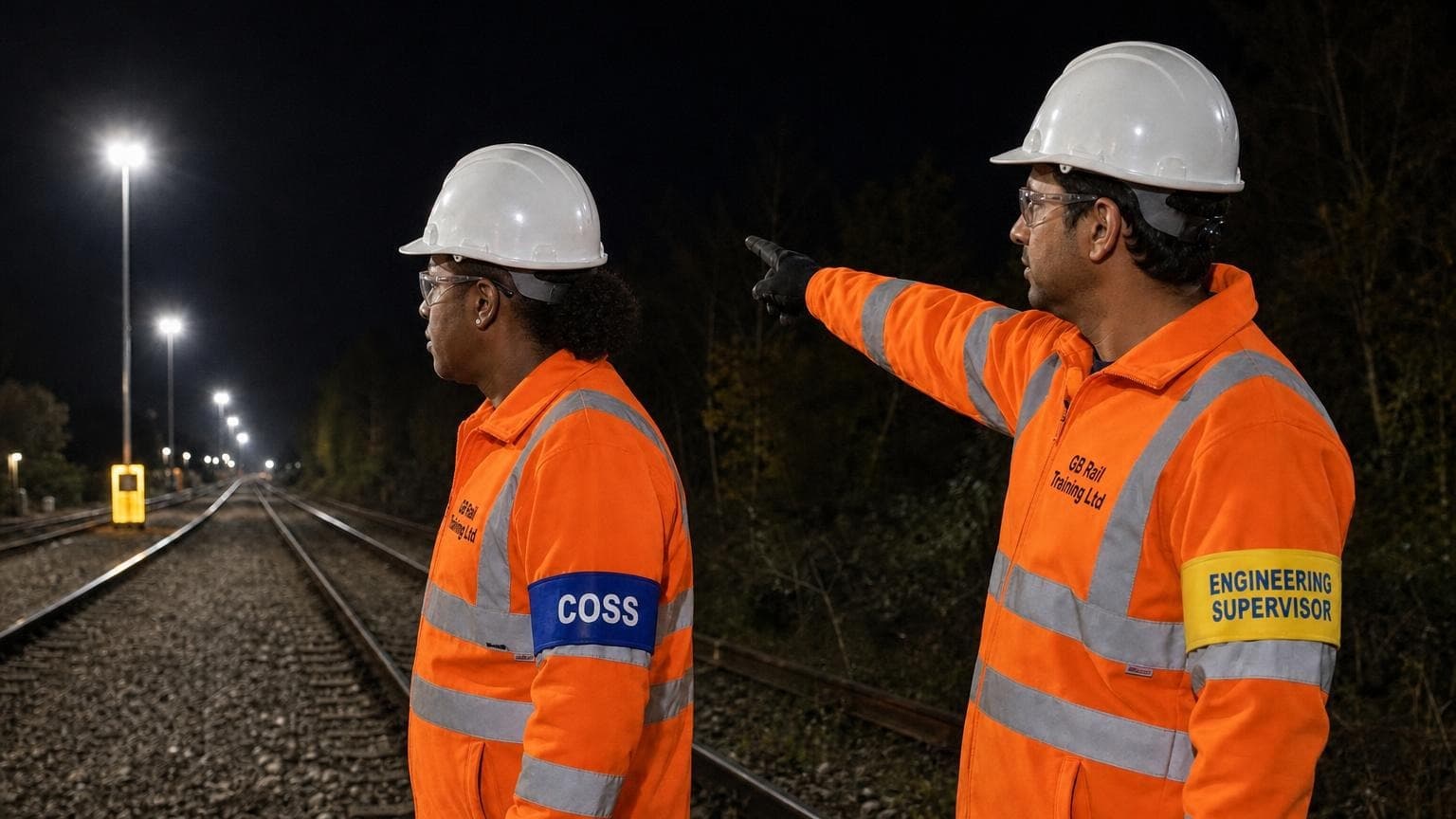
Free until 5 December 2026. Sign-up needed.These changes to the Rule Book come into force on 5 December 2026. Read the list of changes below. Then take the assessment. 10 questions. Pass mark 95%. Time allowed: 15 minutes.Download the one-page list of changes (PDF)What is newHB7 3.2: the rule for patrolling alone has gone. If you work alone within 2 m of an open line and the work does not affect the line, you need a fenced safe system of work or equipment warning.HB9 3.1: in a work site you get the work-site briefing from the ES. You no longer sign the RT3199.HB9: "engineering train or OTP" movements replace "train or OTP" movements. An engineering train includes on-track machines. It does not include OTP.HB9 section 4: transient work sites replace "working outside a work site". The 25 mph PICOP arrangement has gone. Allowed work is only patrolling, inspecting, examining, and placing or removing speed restriction boards, indicators and AWS magnets. The ES sets up the site. When a movement is to enter, the ES tells you. You confirm all work has stopped. You start again only when the ES says the site is set up again. You may work within 100 m of either end if the ES allows it.HB1 7.8 (new): balise readers. Some traction units have balise reader antennae. You must not work under the vehicle or within 1 m of the radar and balise antenna unless you are told the balise reader is not operative.Sources: GERT8000-HB7 Issue 11, GERT8000-HB9 Issue 10 and GERT8000-HB1 Issue 10 (in force 5 December 2026).